KARMA AS INNER RESPONSIBILITY:
"It is not circumstances that determine what we become, but how we choose to respond to them."
(Inspired by the law of cause and effect – Eastern philosophical tradition)
Karma is not a blind force that rewards or punishes from the outside, but a subtle dynamic that arises from within. Every thought, every intention, and every action leaves a mark on our consciousness, creating the conditions for our future. In this sense, we are truly the guardians of our destiny: not because we can control everything that happens, but because we can always choose how to react.
Reacting with awareness means interrupting automatic reactions, observing emotions without being dominated by them, and transforming even the most difficult experiences into opportunities for growth. This is where karma stops being perceived as a "judgment" and instead becomes a tool for evolution: it does not retaliate out of revenge, but as a lesson.
What we sow internally—resentment or forgiveness, fear or trust, closure or openness—tends to be reflected, sooner or later, in our relationships, in the choices we make, and in the opportunities we encounter. Often, this return occurs when we least expect it, precisely because the time of karma does not follow the human clock, but the deeper rhythms of inner maturation.
Becoming master of one's karma, then, does not mean avoiding pain or seeking only "good," but taking full responsibility for one's inner world. It is an act of freedom: recognizing that, even when we cannot choose events, we can always choose who we become through them.
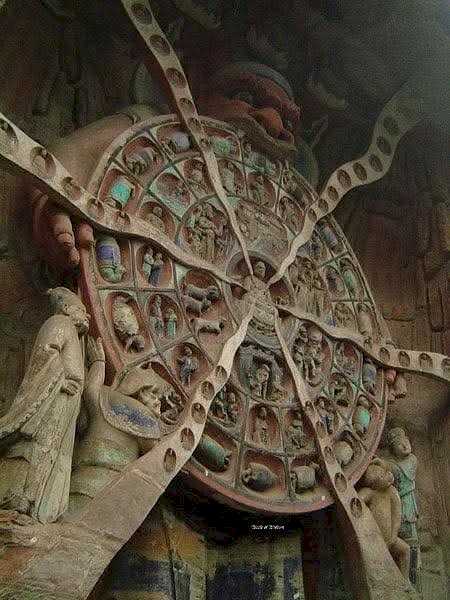
Dazu: The Wheel of Karma
This 8-meter-high Buddhist relief is part of the Dazu rock carving complex in China, built between 1177 and 1249.
The Wheel of "Karma"
The Great Wheel of Creation (or Rebirth) summarizes the Buddhist doctrine of karma: an infinite cycle of reincarnation into higher or lower life forms according to one's past actions. In this sculpture, the demon Mara, the personification of existence, holds the wheel between his jaws and arms. The wheel is supported from below by the personifications of greed (an officer), evil (a soldier), madness (a monkey), and lust (a woman). Six Buddha rays emanate from the wheel, signifying that enlightenment, the goal of all Buddhist practice, allows the seeker to escape the eternal cycle of birth and death.
𝔚𝔬𝔯𝔩𝔡 𝔬𝔣 𝔚𝔦𝔰𝔡𝔬𝔪 (https://t.me/+umNDQY3WJwQzMTBi)